Dr. Rahav Dor, Ph.D.

Portfolio companies and projects
Founded three companies, played vital roles in seven, and built an AI company 4 years before the AI revolution in 2023. Doubled a company's revenue in 3 years, and grew another's 900% in 7. Operated in diverse industries in the U.S. and globally.

Invent a Novel Decentralized Control paradigm
My Ph.D. dissertation pioneers a novel decentralized systems paradigm. It presents a radically new theoretical model for distributed computing.
For the high-tech industry, the paradigm is poised to profoundly impact smart home technology, industrial control, Blockchain, PubSub middleware, and interplanetary communication.

TeamSupport, CTO
Led the company's technology architecture and modernization, migration to the cloud, new product development, and M&A.
Development and integration of SaaS products:
-
Customer Support (mission critical)
-
Chat and Workflow (mission critical)
-
Customer Success
-
Analytics.
The products are accessed by a global customer base and run on multi-cloud (AWS and GCP) infrastructure.

Build a Medical AI Company
Pieces Technologies is a medical/healthcare NLP and AI company. I was one of the key executives who built it in 2016, seven years before the AI revolution of 2023.

Migrate Products and Companies to the Cloud
Designed and spearheaded several companies and product migrations to the cloud. Provided customer engagement seminars and talks when the cloud was in its infancy. Some migrations started as lift-and-shift, while others were cloud native from day one. My strong experience is with AWS.

Grow a company from 20 to $200M
As the CIO of Corporate Express PM, I provided thought leadership, facilitated business scale-up using technology, optimized costs, and reduced time to market to shorten our sales and implementation cycle.
We developed new systems to enable the company's growth, devised processes for frictionless customer implementations, and built hundreds of web solutions.
The outcome was that we grew the business from lows of $20M to over $200M in 7 years, leading to the acquisition by Staples.

Transform a custom service to a Global product phenomenon: Amdocs EMS
Changed the architecture and go-to-market of a service to transform it into a generic product. The product is Amdocs' first generic product, and others followed suit.
In less than a year, EMS emerged as the company's most successful door opener globally. The revenue generated from EMS surpassed all expectations, growing significantly above previous years' performance.

Invent Cyber Security Products and Services
The company designed and built the GV20, an FPGA-based Deep Packet Inspection (DPI) appliance that prevents sensitive documents and data from leaving the company in real-time. I was responsible for inventing solutions to address customers' use cases, predominantly in federal, US military defense, and banking markets.
We then built Securio, a SaaS product that implements our hardware-based technology in an elastic cloud that grew horizontally. Securio featured continuous scanning of global corporate networks and connected devices, exposing security and intellectual property vulnerabilities. It made misplaced, duplicated, and similar documents visible. Learning from our FPGA-based algorithms, Securio had a nominal impact on performance.

Get the Music You Want
I am the inventor and founding CTO of iDoor, the company that commercialized my patent. We built a consumer electronics gadget and used machine learning (ML) and pattern recognition techniques to match audio snippets to original music.

Build a computer expansion card: The Thinking Cashier
Thinking Cashier is an ISA computer expansion card that transforms a regular PC into an intelligent Point of Sale (POS).

Build a mass-market computer chip: Up2Date
Up2Date is a real-world clock for slotless computers.
My father, Lior Dor, invented and designed it. I built and empirically evaluated it, authored the system driver (kernel), and commercialized it.

Build a mass-market tutorial product: HelpU
Built off-the-shelf consumer software that provided help with all OS commands. I authored the content. This wildly successful product became a popular (it ran for a few years) training class that People & Computers Magazine offered.

Build an AI agent: Packman AI
As a group of students, we wrote an AI Packman agent, but as any AI may become, it had other life plans.
Each agent competed in online games against other agents. Every night, each agent played against all other Washington University in St. Louis agents and each of the Stanford agents. This amounts to over 200 games each night unless an agent loses.
Our algorithm was never defeated during our semester (4 months). It was so adaptive that our agent continued to live and win games for two additional semesters. With no change to our algorithm, while all other students in both schools improved their agents daily, it was beaten only once. Nevertheless, our agent learned from that experience and was back on its winning streak after that loss.
It may still be out there, prospecting games or building the Terminator Packman.
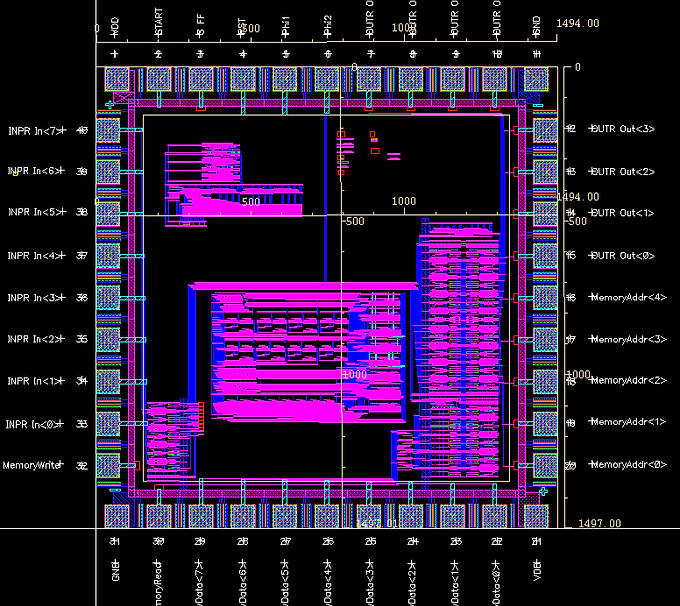
Design and fabricate VLSI
Designed a VLSI chip. A RISC CPU using AMI 0.6 micron technology. The silicon dimensions are 1.5 square millimeter.

Design and Build a complete ERP system: The Visual Office
Solicited the voice of customers and prospects in diverse markets and domains of practice, from medium businesses to large distribution and manufacturing plants. Conducted business analysis and authored the Visual Office (VO), an all-encompassing ERP system.
The primary innovation was that we never built an ERP system. Instead, we built user-friendly configurators and compilers that adapted the system to the needs of each business. Everything was customizable (UI and logic) without changing a single line of code or dragging other customers' complexities into a deployment.
It was not our original design objective. Nevertheless, this design allowed us to make the system multi-lingual when IBM won the United Nations (UN) hardware contract. We added a UI compiler to support the implementation but did not change a single line of code in the ERP logic.

Build a mobile app: Science Nature And Photography (SNAP)
Joy Chiang, Bryn Beez, Adam Kraft, and I completed the development of SNAP in April 2010, an iPhone app that enables citizen scientists to take pictures and send them to AMOS (the Archive of Many Outdoor Scenes). SNAP tags images with GPS, references to Earth's magnetic pole, and additional data and annotations by the picture taker expand AMOS reach and enable new research. Scientists can design and designate research to occur anywhere on Earth, and users can take images of these locations using SNAP. Users can subscribe to these feeds based on their expected travel and interests.

Build an agriculture system: Shtil
Shtil (plant in English) is a system for managing agriculture businesses. It includes data about plants, feeding and caring, and a point of sale.

Build a service dispatching and free text knowledge base system: Probe
Before massively parallel server farms made full-text search plausible, I researched various ways to index and store a large corpus of textual data for fast retrieval. At the culmination of the research, the apparatus returned results in sub-second time when running on a single 80286-based computer. With this technology, we built Probe, a technician management system with a searchable knowledge base.

Build an Electronic Medical Records system
This product started as a management system for surgery centers, including medical files and scheduling. Its novelty was the requirement to connect to all medical devices and apparatus in the clinic and optimize surgeon time.

Build a Data Center
For Corporate Express PM, I led the design and construction of a data center that served our US-based and global offices. This small center hosted our business systems, web hosting for several hundred websites, remote access to ERP data for our traveling sales agents, and global VOIP interconnect.
The company's legacy VAX VMS was hosted in the center, alongside Dell servers running Microsoft Windows servers, SQL servers, and CISCO equipment. A SONET ring, EMC storage and replication, and a disaster recovery site in Denver provided survivability.
Credits
Throughout my career, I have had the privilege of collaborating with many creative and talented individuals. A lot of this is credited to Nathan Kazaz, who opened my eyes to the philosophy of hiring people who are better than you. Attracting brilliant people who know their craft has been my goal ever since.
Greg Sullivan invented the FPGA-based deep packet inspection appliance. I owe him for introducing me to his mad scientist endeavors, often before their time. Together with Bill Edwards and Joe Leonard, we envisioned futuristic cybersecurity technologies. Many addressed federally sponsored whitepaper calls and cannot appear on this site. I enjoyed every day in the office with this cohort and will always remember them fondly.
Packman AI and VLSI 8-bit RISC CPU were not forged in my brain. These two graduate-level projects were long, challenging, and product-like in scope. We packaged and completed them to a level worthy of mentioning. I also immensely enjoyed working on them, and this is my site, so here we go, they are mentioned. The Packman AI as a vehicle for teaching and its gaming infrastructure is due primarily to Dr. John DeNero and Dr. Dan Klein, both at Berkeley University. I just happened to be in the right class at the right time and lucky enough to join a team smarter than me. Our team members were Peng Li, Daniel Lazewatsky, and Steve Cole. Gang, working with you was a pleasure and intellectually stimulating. Interestingly, in 2024, as I updated my site, I noticed that all four team members are now doctors. This is something to consider for those who do not see the value of a good education. For more details about where Packman AI is now (if it was not eaten), click here.
The VLSI 8-bit RISC CPU is credited to the renowned Dr. Viktor Gruev. I wish I had more opportunities to work near his brilliance. He continuously makes new science in his Biosensors lab, and I highly recommend following his work.
Additional attributions appear on individual project pages. Please send me a note if there is a project that you believe should be credited to someone, and I will promptly correct that.